
This article is written by Anna Schwartz. The newsrooms or editorial departments of Tribune Publishing Co. are not involved in the production of this content. Content oversight provided by Studio 1847.
Steven Maksin has long had an eye for value.
As CEO of his own investment firm, Moonbeam Capital, he has used his training as a lawyer and accountant to uncover undervalued real estate properties.
For example, Maksin bought New Jersey’s distressed Burlington Center Mall in 2012 for $3.4 million. Six years later, he sold it as part of a sprawling new development called The Crossings for over $22 million. He also profitably sold properties ranging from the Cortana Mall in Baton Rouge, Louisiana, to Durham Office Park in Durham, North Carolina, and many others.
In addition to having an eye for value, Maksin has one for beauty, and he has become a noted collector of antique firearms and artwork. He owns landmark works by Italian Renaissance master Titian, Baroque figures Caravaggio and Mattia Preti and Rococo masters like Giambattista Pittoni and Carlo Magini, as well as the Spanish surrealist Salvador Dalí.
But acquiring masterpieces isn’t Maksin’s only mission — he takes the most pleasure in lending them to major institutions like the Metropolitan Museum of Art in New York and the Art Institute of Chicago and sharing them with the public.
A native of Kiev, Ukraine, Maksin arrived in the Brighton Beach neighborhood of Brooklyn, New York, in 1989 and immediately requested political asylum. His seemingly distant dream of becoming an American was finally within reach.
Maksin vividly remembered meeting Daniel and Karen Pritzker in 1988 in St. Petersburg, Russia. The Pritzkers invited him and other friends to a dinner and encouraged Maksin to come to the U.S. and get the best education possible.
Once in the U.S., Maksin graduated with honors from Kingsborough Community College. Then he graduated cum laude from the Stern School of Business at New York University. After spending three years at Coopers and Lybrand as a tax advisor, Maksin went back to school and graduated from the Benjamin N. Cardozo School of Law.
While there, he was invited to become a member of the Cardozo Law Review. He also received the Dr. Samuel Belkin Award for scholastic achievement and exceptional contribution to the law school. Finally, in 2002 he graduated from New York University Law School with a Masters of Tax Law.
At that moment, Maksin was finally ready to make his next move. So, in January 2002 he left PricewaterhouseCoopers to open up his own law and accounting businesses with a focus on private equity and real estate investments.
“America is a land of freedom and opportunities,” he says. “I’ve been blessed by the Almighty, and my passion for art is my way of giving back to the community at large.”
When it comes to acquisitions, Maksin looks for pieces that tell a story, whether it is from the age of kings in France, the Old West or the Italian Renaissance.
“I only buy art and collectibles which were not seen in the past,” he says.
His professional work now is to find value in failing malls and turn them into successful properties. Maksin’s personal mission is to look for value and beauty in long-hidden masterpieces.
One such unusual work is a 19th-century French Le Page Moutier double-barrel percussion shotgun with an elaborately carved ebony stock. All the more remarkable given its history is its excellent condition, with carefully detailed hunting figures visible like a fox, a lion and a boar.
After acquiring it in 2024, Maksin soon lent it to the Art Institute of Chicago. Until he stepped up, the museum had precious few French firearms of note. These firearms represent an example of “art on steel,” and Maksin hopes these lent works promote new appreciation for pieces that are little-known among the public.
Maksin also acquired four 19th-century Winchester rifles, icons of the Old West, engraved with gold. Previously kept in private vaults, these pieces were in pristine condition. Now they are brilliant, loaned works at the Met, where Maksin is a member of the Negroli Society, an elite group that supports the museum’s Department of Arms and Armor. He is also a member of the Department’s Visiting Committee.
Besides their connection to the Old West, what attracted him to these objects?
“They represent freedom of action, the ability to be free from government, and open spaces,” Maksin says.
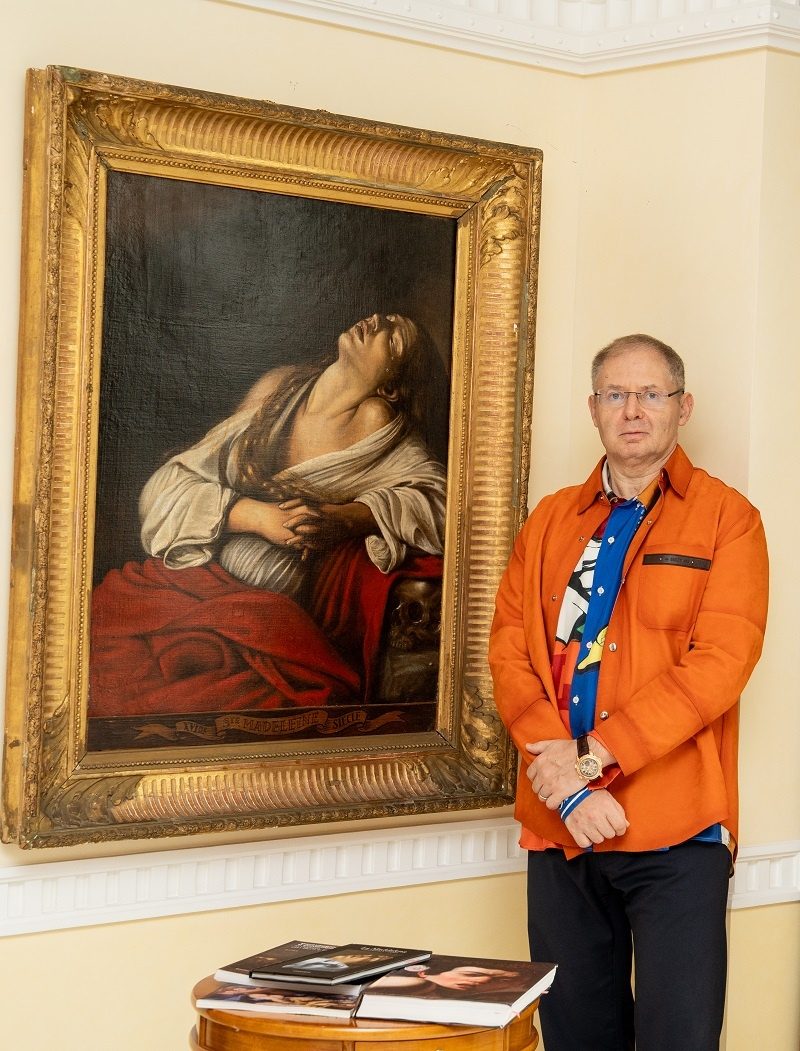
It is a long way from the Wild West to the Italian Renaissance, but perhaps the crown jewel in Maksin’s collection is Titian’s “Penitent Magdalene.” One of the painter’s masterpieces, it’s famous for its emotional, tearful figure, combining the sensual with the spiritual. Those elements influenced famous artists like Peter Paul Rubens and Caravaggio.
After being unseen for generations, and after a masterly restoration, Maksin made it available for viewing in Venice. It was a homecoming for the “Penitent Magdalene” — the work was exhibited a stone’s throw from the church where Titian is buried.
Echoing Maksin’s success in seeing new possibilities in once overlooked malls, three works held by Maksin in a Las Vegas vault were identified by art historians in 2024 as having been created by Pittoni, a 17th-century Venetian master.
“I was very excited to know I had Pittonis in my collection — these are not common finds,” Maksin says.
Moving quickly, Maksin made several leading paintings available for a landmark exhibition in 2025 in Naples. The range of Maksin’s vision extends to the 20th century, including Dalí.
One theme he favors is the triumph of good over evil. An example is a drawing by Raphael depicting St. George slaying the dragon — the original painting of which is in the National Gallery in Washington.
Venice, New York, Chicago — these cities are a long way from Maksin’s hometown of Kiev. But he still maintains a home in Brighton Beach, connecting him to his beginnings in the United States.
“I’ve been very blessed to be in the United States,” he says. “I always remember that.”
Maksin also spends time in Miami and Las Vegas. But in his collection there is a reminder of his roots. He owns one of the earliest examples of coins and monetary units from Ukraine — the hryvinia — from 1,000 years ago.
Maksin’s happiest moments are contemplating the works in his collection and scouting the landscape for new acquisitions that can be shared with the public.
Summing up his passion for art, he says, “It gives me a chance to be a tireless time traveler who moves through centuries in search of the Holy Grail: truth itself.”
— Provided by Pivotal Communications